
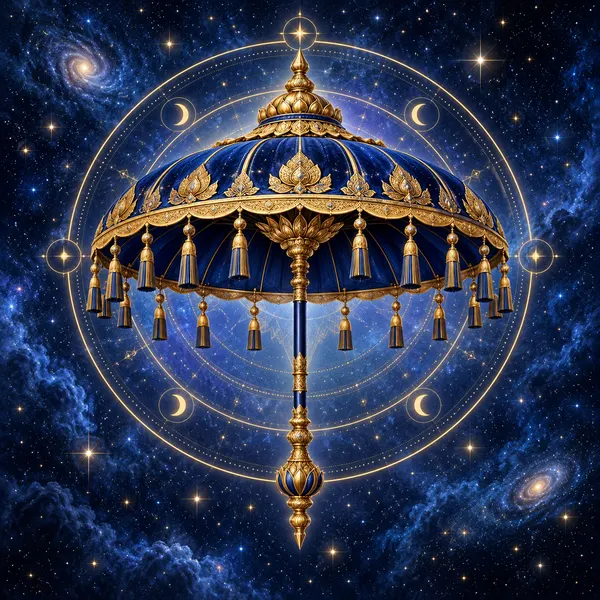
Jyeshtha
Jyeshtha is the eldest, its symbol an earring or umbrella of rank, its deity Indra, king of the gods, with Mercury ruling. This is seniority and the burden that comes with it: the one who protects, who is looked to, who carries responsibility because there is nobody above them to hand it to. It gives real authority and a sharp, capable mind. Its shadow is pride, and the isolation of the person who has decided they cannot show weakness. A month on Jyeshtha asks you to occupy your actual seniority — and to notice where the eldest-child reflex is doing work that is not yours. Protection given past the point of usefulness makes the protected smaller.
A quiet month
Nothing slow is crossing Jyeshtha this month, and your ruler Mercury sits in Libra, the twelfth from your stars — retreat, release, foreign places, sleep and what is spent rather than kept. Quiet months with this emphasis are genuinely low-energy, and it is better to plan for that than to fight it. Rest is not wasted here; it is the actual work. It is also a good configuration for closure, for solitude, and for letting go of something whose expiry you have already privately acknowledged.
Your ruler: Mercury
Your nakshatra is ruled by Mercury, so this month runs on information and conversation. Where Mercury sits is where the useful exchange is happening — and when Mercury turns retrograde, your whole month acquires a review-and-revise quality rather than a forward one.
Moon days 15 Oct
The Moon passes through your nakshatra for about a day each month, and those are the days its themes run closest to the surface. They are good for anything needing instinct rather than analysis, and for beginnings that want emotional weight behind them. The dates are listed below. They are short windows, so use them deliberately rather than waiting for a mood to arrive.
What changes this month
These are the month's actual turning points — the dates a graha changes sign, turns retrograde or direct, and the two lunations. A sign change is the moment a graha starts asking a different question, so the days around one are where a month visibly shifts rather than simply continues. A station matters more than an ingress: a graha standing still before it turns tends to bring whatever it governs to a head, and the effect is felt for several days either side rather than on the date itself. The Moon's own sign changes are left out here because it moves through one every two and a half days, which is noise at this scale; its passage through your nakshatra is given its own section above.
- 3 OctVenus turns retrogradeVenus turning retrograde sends affection and value backwards. Old attachments reappear and prices stop meaning what they did; it favours reconsidering what something is worth over committing to it.
- 10 OctNew Moon in Virgo, HastaA new Moon is the Sun and Moon in the same sign, which is the dark point of the cycle rather than a bright one. It is the beginning of a lunar month: the sign and nakshatra it falls in name what is being started, and the fortnight after it is when a start made here has the tide behind it.
- 17 OctSun enters LibraThe Sun changing sign moves the month's centre of gravity. Where it goes is where attention, authority and the sense of what matters concentrate for the next four weeks, and whatever that area of life has been waiting for tends to get looked at squarely rather than deferred again.
- 24 OctMercury turns retrogradeMercury turning retrograde folds the month's talking back on itself. Plans get revisited, old correspondence resurfaces, and arrangements made quickly tend to need making again. It is a poor window for signing and a good one for rereading.
- 26 OctFull Moon in Aries, AshwiniA full Moon is the Sun and Moon opposite each other, so whatever has been building becomes visible and, often, becomes a question of balance between two things rather than one. The sign and nakshatra it falls in name where that visibility lands. It is a culmination, not a beginning.
- 31 OctJupiter enters LeoJupiter changes sign about once a year, so this is a genuine turn rather than a monthly variation. It marks where growth, permission and good faith are available for the next twelve months — and, less comfortably, where things are inclined to overreach.
The wider chapter
Behind every month sits a slower story. Rahu and Ketu hold a sign for about eighteen months, so the axis they occupy is the chapter this whole run of months belongs to, not a monthly variable. Ketu's sign shows where something is being emptied out and released across the period; Rahu's shows where the appetite and the ambition are pulling. When that axis changes sign the chapter genuinely turns, and it is worth marking. The current placement and the date it changes are given with this reading.